


Understanding how to convert fractions into decimals is a fundamental skill in mathematics. One fraction that often appears in various calculations is 5/8. Converting 5/8 as a decimal can help students, professionals, and everyday users in financial calculations, measurements, and problem-solving.
This comprehensive guide explores the process of converting 5/8 as a decimal, practical applications, tips for accuracy, and related concepts like percentages and decimals in daily life.
What Does 5/8 Mean?
The fraction 5/8 represents five parts out of eight equal parts of a whole. In mathematical terms:5/8=85
Fractions are an essential way to represent numbers that are not whole, and understanding how to convert them to decimals allows for easier calculations in both academic and real-world situations.
How to Convert 5/8 as a Decimal
Converting 5/8 as a decimal is simple using basic division. Here’s the step-by-step method:
Step 1: Divide the Numerator by the Denominator
- Numerator (top number) = 5
- Denominator (bottom number) = 8
Perform the division:5÷8=0.625
Step 2: Result
- The decimal equivalent of 5/8 is 0.625
This decimal can now be used in calculations that require numbers in decimal form rather than fractions.
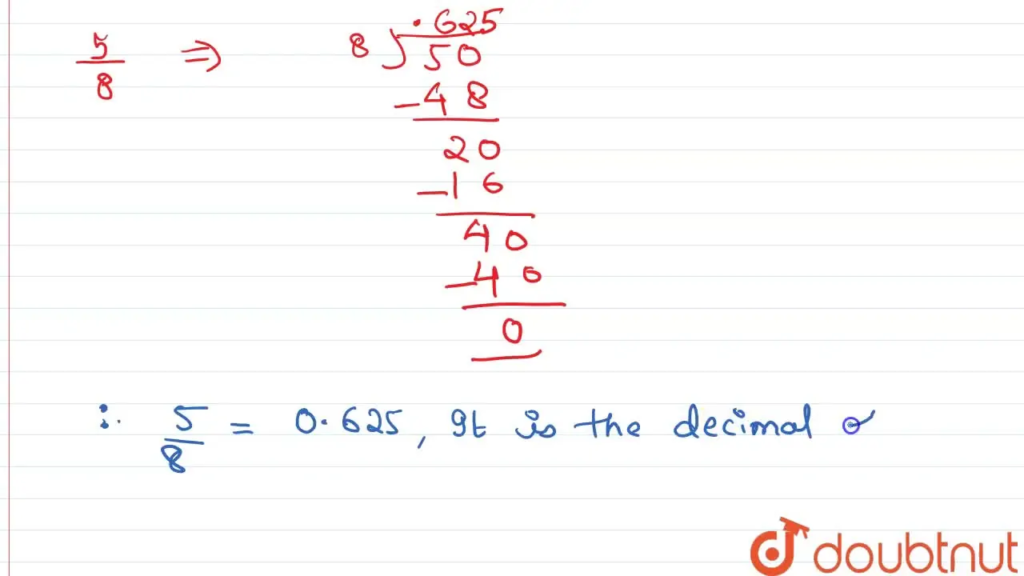
Using Long Division to Convert 5/8 as a Decimal
If you want a manual method, long division is effective.
- Divide 5 by 8
- Since 5 is smaller than 8, add a decimal point and zeros (5.000)
- Perform division step by step:
- 8 goes into 50 six times (6 × 8 = 48) → remainder 2
- Bring down 0 → 20
- 8 goes into 20 two times (2 × 8 = 16) → remainder 4
- Bring down 0 → 40
- 8 goes into 40 five times (5 × 8 = 40) → remainder 0
So, 5 ÷ 8 = 0.625 ✅
Quick Method Using Fraction to Decimal Conversion Table
For common fractions, you can also use a conversion table:
| Fraction | Decimal |
|---|---|
| 1/8 | 0.125 |
| 2/8 | 0.25 |
| 3/8 | 0.375 |
| 4/8 | 0.5 |
| 5/8 | 0.625 |
| 6/8 | 0.75 |
| 7/8 | 0.875 |
| 8/8 | 1 |
This table is handy for quick conversions without calculations.
Converting 5/8 as a Decimal to Percentage
Many real-life applications require percentages instead of decimals. To convert 5/8 as a decimal to a percentage:0.625×100=62.5%
So, 5/8 = 0.625 = 62.5%.
This is particularly useful in finance, statistics, and academic grading systems.
Applications of 5/8 as a Decimal
Understanding 5/8 as a decimal is useful in many fields:
1. Financial Calculations
Decimals are essential in budgeting, interest calculations, and tax computations. For example, if you need 5/8 of $100, converting to decimal:100×0.625=62.5
So, 5/8 of $100 = $62.50.
2. Cooking and Recipes
Recipes often use fractions, and converting to decimals helps with precise measurements:
- 5/8 cup of flour = 0.625 cup
Using decimals ensures accuracy when scaling recipes up or down.
3. Measurements in Construction
In carpentry or construction, measurements often use fractions. Converting to decimal helps with:
- Tool calibrations
- Cutting measurements
- Material estimation
For instance, 5/8 inch = 0.625 inch.
4. Academic Use
Students often encounter 5/8 as a decimal in math problems involving fractions, probability, and ratios. Using decimals simplifies calculations in:
- Algebra
- Statistics
- Geometry
5. Computer and Coding
In programming, fractions are typically handled as decimals. For example:
- 5/8 as decimal = 0.625
- Useful in CSS (like width: 0.625rem), calculations, or probability simulations
Tips for Accurate Conversion of 5/8 as a Decimal
- Always double-check division results
- Use a calculator for faster results
- Remember common fractions like 1/2, 1/4, 1/8, which are easy to convert
- Write fractions in simplest form before conversion
Other Common Fraction to Decimal Conversions
Knowing 5/8 as a decimal is useful, but other fractions are also frequently needed:
| Fraction | Decimal |
|---|---|
| 1/2 | 0.5 |
| 1/4 | 0.25 |
| 3/4 | 0.75 |
| 1/5 | 0.2 |
| 2/5 | 0.4 |
These conversions help in mental math, financial planning, and academic work.
Decimal vs Fraction: When to Use Each
- Fractions: Good for recipes, craft measurements, and traditional teaching
- Decimals: Preferred in technology, finance, statistics, and modern calculations
Since 5/8 as a decimal = 0.625, using decimals simplifies many real-world tasks.
Shedding Light on Repeating and Terminating Decimals
Decimals like 0.625 are called terminating decimals because the digits end after a few places. Some fractions convert into repeating decimals, like 1/3 = 0.333…
Knowing this helps in:
- Precision calculations
- Scientific notation
- Programming logic
Practical Exercises: 5/8 as a Decimal
Here are some practice scenarios:
- Convert 5/8 into a decimal → 0.625 ✅
- Multiply 5/8 by 16 → 16 × 0.625 = 10
- Convert 5/8 to percentage → 0.625 × 100 = 62.5%
These exercises show the real-life value of understanding fraction-to-decimal conversions.
Using 5/8 in Everyday Life
- Shopping: Discount calculations like 5/8 off
- DIY Projects: Measurements in inches or centimeters
- Education: Math homework or tests
The decimal form 0.625 is easier for calculators and digital tools.
Common Mistakes When Converting 5/8 as a Decimal
- Dividing incorrectly → always use long division or calculator
- Forgetting the decimal point → 5 ÷ 8 ≠ 625
- Confusing percentage with decimal → 0.625 ≠ 62.5% unless multiplied by 100
Tools to Convert Fractions Like 5/8 to Decimal
- Online fraction-to-decimal converters
- Scientific calculators
- Math software (Excel, Google Sheets)
These tools save time and reduce errors.
Summary: 5/8 as a Decimal
- 5/8 as a decimal = 0.625
- As a percentage = 62.5%
- Useful in finance, recipes, construction, academics, and programming
- Conversion methods include division, long division, or tables
Mastering 5/8 as a decimal improves accuracy in calculations and enhances understanding of math concepts.
Final Thoughts
Understanding 5/8 as a decimal is more than a simple math exercise—it’s a skill used in everyday life. From shopping discounts and recipe adjustments to coding and construction, converting fractions into decimals ensures precision and efficiency. With practice, tools, and awareness of common mistakes, anyone can confidently work with 5/8 as a decimal and related fractions.
